How Data Flows Through Your Organization
In my 15 years of experience with BI projects, I see the same pattern over and over: organizations struggling with data because they don’t understand how data actually flows through their organization. They start with technology and then wonder why their dashboards don’t answer the right questions.
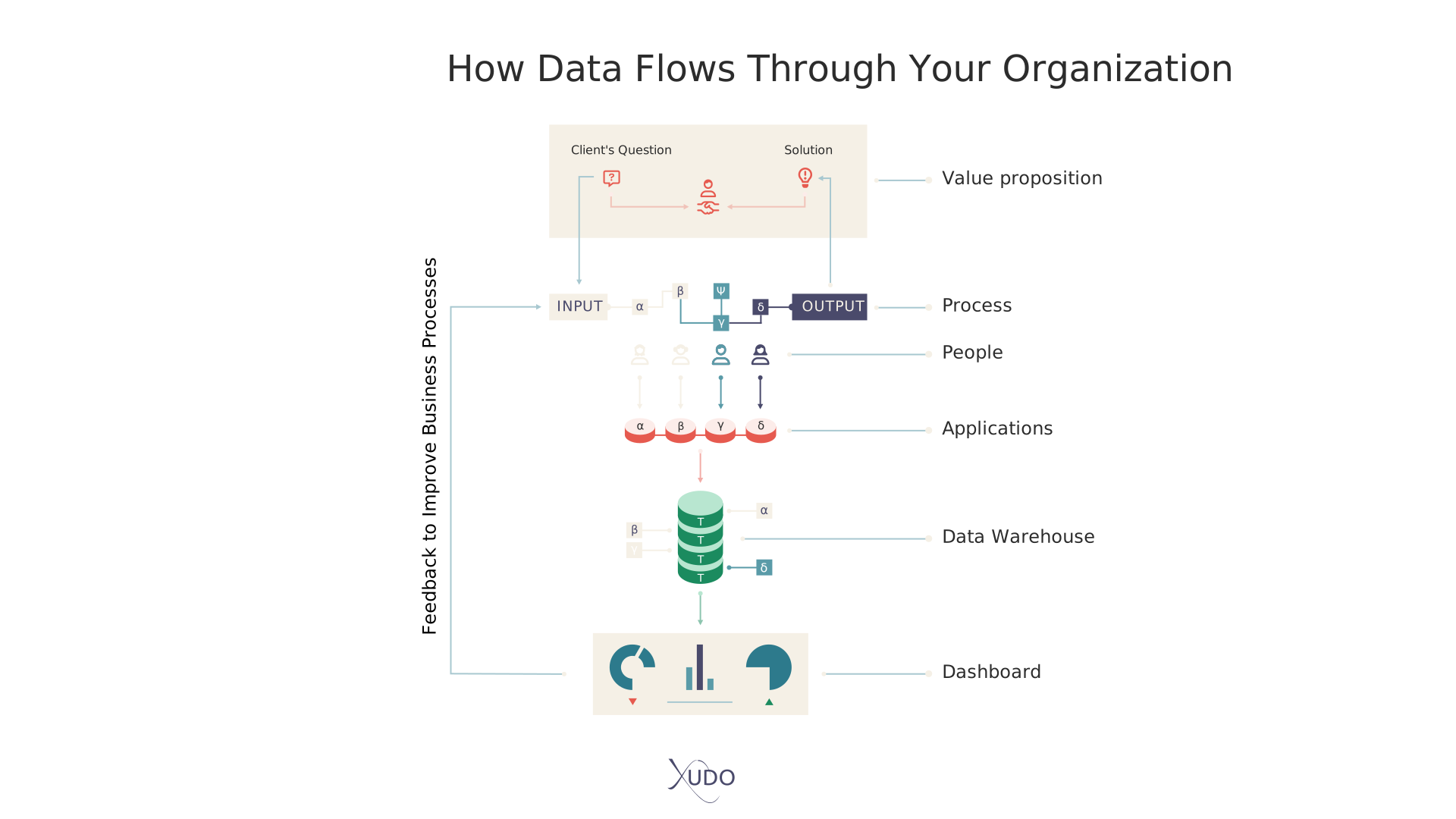
The dataflow framework is my way of simplifying this complexity. It describes how signals from your daily operations are transformed into strategic insights that help you make better decisions.
From Process to Dashboard: The Journey of Data
Every day, you execute processes. Processes to deliver products, support customers, handle administration. During these processes, signals emerge—data that tells you something about what’s happening. An order is placed. A customer calls with a question. An invoice is paid.
These signals are captured in software applications. Your ERP records transactions. Your CRM tracks customer interactions. Your time-tracking system monitors hours. When these signals are stored in the databases of these applications, you transform raw events into structured data.
But it doesn’t stop there. This data must be transformed before it’s useful for analysis. An ERP database is optimized for transactions, not for reporting. You need an intermediate layer that converts this data into a format suitable for dashboards—a data warehouse.
In the data warehouse, different data sources are combined, transformed, and structured according to business logic. This is where your Single Source of Truth (SSOT) emerges—the central place where everyone looks at the same, verified version of a KPI.
Finally, these insights are visualized in dashboards. These dashboards help you spot trends, identify bottlenecks, and make better decisions based on facts instead of gut feeling.
Why This Framework Matters
Without understanding this flow, you often start in the wrong place. You buy a BI tool and then wonder what you can do with it. This is backwards.
The dataflow framework helps you start with the right question: which decisions should this data enable? From there, you work backwards: which KPIs do you need? What data do you need to calculate those KPIs? Where does that data come from? And how do you transform it into usable insights?
In my Vision-to-Growth Framework, I use this dataflow framework as the foundation. During the Strategic Sanity Check, I identify which decisions matter to your C-suite. Then I build the AI-Enhanced Foundation—the data pipelines and warehouses that transform these signals into insights. Finally, I close the loop with training and dashboards so you achieve absolute operational control.
Closing the Loop
The beauty of this framework is that it forms a circle. When you use insights from your dashboards to improve your processes, those processes change. And when processes change, your data architecture must also be adapted to capture these new signals.
This is where many organizations get stuck. They build a dashboard, but forget that when processes change, the underlying applications must also be adapted. And when applications change, the data architecture must also be updated to integrate the new data.
In my A-to-Z implementations, I ensure this loop is closed. I don’t just build the technical infrastructure, but also help you understand how this flow works so you can continue independently.
Practical Application
The dataflow framework helps you ask the right questions before looking at tools. Start with your strategy: which decisions do you need to make? Then work backwards to the data you need to support those decisions.
This is exactly what I do during a leadership alignment session. Together, we identify the key operational and strategic questions that currently lack clear, fact-based answers. By mapping these questions to your existing data sources, we build a roadmap where every dashboard and data pipeline serves a direct, measurable business purpose.